
Table of Contents
- What Makes Handcrafted Unique Jewelry Different
- Understanding Handmade Artisan Jewelry Craftsmanship
- Jewelry Made with Natural Stones: Quality and Selection
- Reclaimed Copper Jewelry: Sustainability and Character
- Handmade Sterling Silver Jewelry: Durability and Design
- How to Evaluate Handcrafted Jewelry Quality
- Care, Customization, and Long-Term Value
- Conclusion
- Frequently Asked Questions
Last Updated: October 9, 2026
What Makes Handcrafted Unique Jewelry Different
When you buy handcrafted unique jewelry, you're getting something fundamentally different from mass-produced pieces. Each item is made individually, by hand, so no two are exactly alike, every curve, stone placement, and join is a deliberate result of human skill.
Mass production relies on molds, machines, and repetition. Handcrafted unique jewelry relies on technique, material knowledge, and the maker's eye, a difference that shows up in durability, feel, and how a piece ages.
The bohemian and minimalist aesthetic I work with emphasizes raw materials and natural textures. Reclaimed copper develops a patina that tells a story; sterling silver darkens and polishes in response to how you wear it. These aren't flaws, they're the piece becoming part of your life.
Understanding Handmade Artisan Jewelry Craftsmanship
Handmade artisan jewelry craftsmanship means designing and creating jewelry entirely by hand, using traditional metalworking and stone-setting techniques rather than industrial machinery.
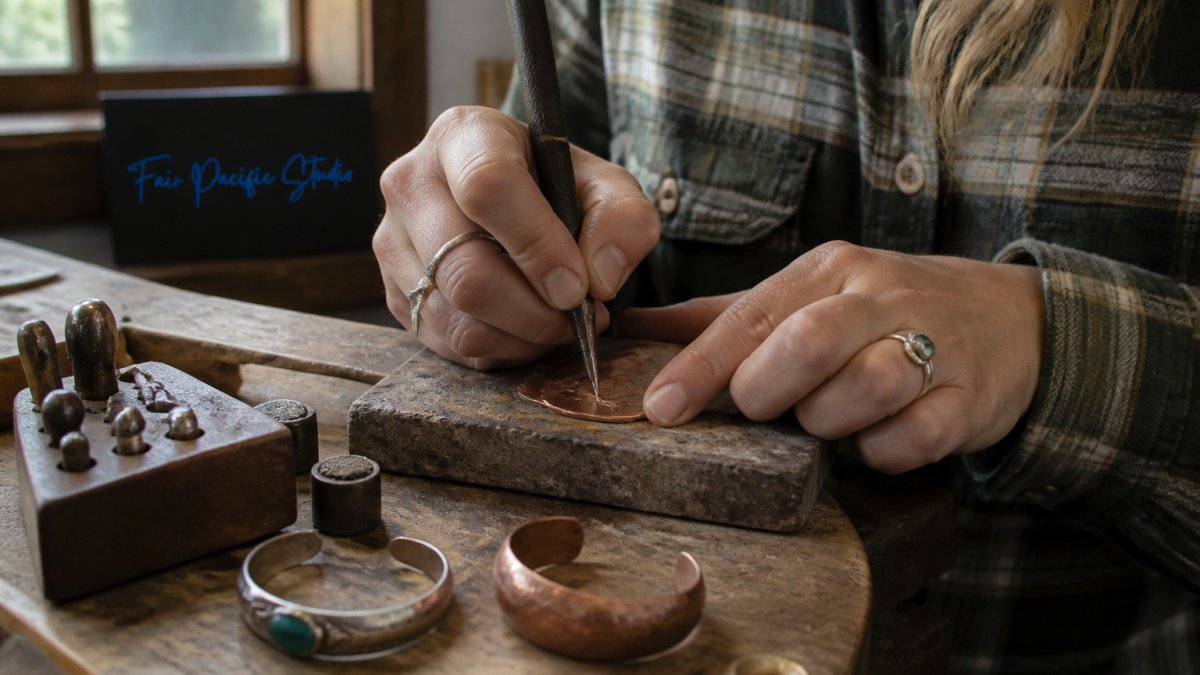
I work primarily with reclaimed copper, sterling silver, and brass. Each behaves differently under the hammer, at polish, and in heat. When I forge a copper cuff, I read the metal's resistance and color shift, something a machine can't do.
Handmade artisan jewelry also means I can solve problems as they arise, adjusting a setting if a stone sits differently than expected, or modifying a clasp for someone with dexterity concerns.
The time investment is real: a single piece might take hours to several days. That's not inefficiency, the slower pace allows for better decisions, better finishing, and quality control only human hands provide.
Jewelry Made with Natural Stones: Quality and Selection
Natural stones are where handcrafted unique jewelry earns its keep, and where buyers get most confused.
Start with hardness, because it predicts wear. The Mohs scale runs 1 to 10. For everyday rings, most jewelers steer clients toward stones at 7 or above, quartz (7), amethyst (7), citrine (7), and garnet (6.5-7.5) all hold up reasonably well (Natural Gemstones).
Cleavage and toughness are separate from hardness. Diamond is hardest but has perfect cleavage, a sharp hit can split it.
Treatments are normal, hiding them is not. Heat treatment is routine for sapphire, ruby, amethyst, and citrine.
Cut and color behavior. A well-cut stone returns light to your eye; a shallow or overly deep cut leaks it.
Setting style changes how a stone lives. A bezel wraps metal around the stone's edge and protects it, good for softer stones and active wearers.
Sourcing, in plain terms. I can tell you the country or region my stones came from.
A quick buying checklist for stones:
| Question | Why it matters |
|---|---|
| What is the stone, exactly? | Species and variety, not just a trade name |
| What is its Mohs hardness? | Predicts daily-wear suitability |
| Has it been treated? How? | Affects value, care, and disclosure |
| Natural, lab-grown, or imitation? | Affects price and expectations |
| How is it set, bezel, prong, channel? | Affects protection and wear |
| Where did it come from? | Traceability and sourcing claims |
None of this requires a gemology degree, just better questions, and a maker willing to answer them.
Reclaimed Copper Jewelry: Sustainability and Character
Reclaimed copper was already in circulation, pulled from old roofing, electrical wire, plumbing, industrial scrap, and salvaged machinery, then cleaned, sorted, and reworked. It's chemically identical to newly mined copper; what changes is provenance.
Why it matters. Copper mining is energy- and water-intensive, generating significant waste rock and emissions (Copper mining, critical minerals, and long-term drought in the Southwest United States).
What reclaimed copper looks like in practice. Salvaged copper arrives as sheet, tube, wire, or bar, often carrying oxidation, solder residue, paint, or lacquer that must be removed first.
How it compares to other metals.
| Property | Copper | Sterling silver | Brass |
|---|---|---|---|
| Purity (typical) | ~99% Cu | 92.5% Ag | ~60-70% Cu, rest Zn |
| Mohs hardness (approx.) | 3 | 2.5-3 | 3-4 |
| Tarnish behavior | Patinas green/blue over time | Darkens to gray-black | Dulls to yellow-brown |
| Skin reaction risk | Some people react to copper | Low | Possible if zinc-sensitive |
| Best for | Cuffs, pendants, statement pieces | Fine detail, chains, settings | Cost-effective everyday pieces |
Copper is softer than brass and about the same as sterling silver, easy to forge and shape, but easier to scratch.
Patina: what it is and how to steer it. Copper reacts with oxygen, moisture, and sulfur compounds to form a surface layer. Early on it is a warm brown; over years it can shift toward the green-blue commonly called verdigris. Some love that; some want the bright penny look. Both are manageable:
- To keep it bright: polish with a copper-specific polish and a soft cloth, then apply a thin protective wax or lacquer. Reapply every few weeks if worn daily.
- To encourage patina: leave it unworn in open air, or wear it consistently and let skin oils and humidity do the work. Do not seal it.
- To reset it: a mild acid, lemon juice or vinegar with a little salt, will strip oxidation back to bare metal. Rinse and dry thoroughly afterward.
Skin sensitivity. Some people develop irritation from prolonged copper contact. If you've reacted to base-metal jewelry before, choose a piece with a coated interior, sterling silver and gold-filled are safer bets for sensitive skin.
Care and repair. Copper dents more easily than silver or brass, so store cuffs and bangles separately or in a soft pouch.
The value case. Reclaimed copper is typically the most affordable metal I work with, so I can build larger, more sculptural pieces.
Handmade Sterling Silver Jewelry: Durability and Design
Handmade sterling silver jewelry is the standard for pieces meant to last decades. Sterling silver is 92.5% pure silver, mixed with other metals for strength, durable enough for daily wear, responsive enough for detailed work, and it develops a patina many people love.
Silver's durability comes from its density and corrosion resistance, it doesn't rust or degrade from moisture. It will tarnish, but tarnish is cosmetic and reversible; a simple polish brings it back.
Silver allows for precision copper sometimes resists, thinner walls, more delicate connections, finer detail work. That's why it's the material of choice for intricate pieces, fine chains, and settings that must hold stones securely.
The weight of silver matters too, substantial on the body, not heavy, but present. That presence signals quality, and you can feel the difference between something handmade and something hollow and thin.
How to Evaluate Handcrafted Jewelry Quality
Evaluating handcrafted jewelry quality means looking for specific markers of skill and care. Start with joints and connections: seams should be clean, solder joints invisible or minimal, and connections solid.
Look at the finish. Is the surface even? Are scratches intentional (part of the design) or accidental? In minimalist jewelry, finish quality is everything because there's nowhere to hide flaws. A well-finished piece feels smooth and intentional, even when simple.
Check how stones are set. Glue fails, mechanical settings, where the metal holds the stone, last. You should be able to see how the stone is held, and in a quality piece that setting is visible and executed cleanly.
Weight and balance matter. A well-made piece feels balanced on your body; if a bracelet pulls to one side or a necklace sits awkwardly, the maker didn't account for how it would be worn.
Ask about materials. You should get a straight answer about the metal, the stones, and where they came from, vagueness is a sign of corner-cutting.
Care, Customization, and Long-Term Value
Handcrafted jewelry requires minimal care, but intentional care extends its life. Sterling silver and copper both benefit from occasional polishing, a soft cloth and silver polish keeps silver bright, while copper can be polished or left to age naturally.
Remove jewelry before swimming, showering, or physical work, water and friction wear finishes faster, and chlorine and salt water accelerate tarnish. That's basic material science, not fragility.
Customization is a real advantage of working with an artisan maker. If you want a piece modified, clasp changed, stone replaced, sizing adjusted, I can do that. You get input into the design, materials, and final form.
Long-term value in handcrafted jewelry comes from durability and meaning. A mass-produced piece is a commodity that loses value immediately; a handmade piece gains value because it's one-of-a-kind and built to last. Cared for, it can be worn for decades, some pieces become heirlooms.
| Care Task | Frequency | Method | Impact |
|---|---|---|---|
| Polish silver | Monthly or as needed | Soft cloth + silver polish | Maintains shine, prevents heavy tarnish |
| Polish copper | Monthly or as needed | Soft cloth + copper polish | Keeps brightness or manages patina |
| Deep cleaning | Quarterly | Warm soapy water, soft brush | Removes buildup in crevices |
Conclusion
Handcrafted unique jewelry represents a choice: to buy something made with intention, built to last, and designed for how you live. The difference between handmade and mass-produced isn't subtle, it shows up in how the piece feels, ages, and performs over years of wear.
At Fair Pacific Studio, I create handcrafted unique jewelry that combines reclaimed materials, natural stones, and traditional metalworking techniques. Every piece is designed to be worn, develop character over time, and tell a story that's uniquely yours. If you're ready to invest in jewelry made with care and built to last, explore the catalog and find the pieces that speak to you.
Frequently Asked Questions
What makes handcrafted unique jewelry different from mass-produced pieces?
Handcrafted unique jewelry is made one piece at a time by an artisan, meaning no two pieces are identical. Each item reflects the maker's individual choices about design, materials, and finishing. Mass-produced jewelry relies on molds and machines, creating identical copies. Handcrafted pieces show the maker's skill and intention in every detail, from how metal is shaped to how stones are set. This individuality and care in creation is what gives handcrafted jewelry its distinctive character and value.
How can you tell if handmade artisan jewelry is genuinely handcrafted?
Look for signs of individual creation: slight variations in symmetry, visible tool marks that show hand-forging, and inconsistencies that prove no mold was used. Ask the maker directly about their process and materials. Genuine artisans can describe exactly how each piece was made and why they chose specific techniques. Check for transparency about sourcing and materials. A maker who provides documentation about their reclaimed copper demonstrates commitment to quality. Be cautious of claims without evidence, true artisans welcome questions about their craft.
Why does handcrafted unique jewelry cost more than factory-made pieces?
Handcrafted jewelry costs more because each piece requires hours of skilled labor, individual design attention, and higher-quality materials. Artisans invest time in learning their craft, sourcing ethical materials, and perfecting techniques. When you buy directly from a maker, you're paying for their expertise and the time invested in your specific piece, not factory overhead or retail markups. You're also supporting a small business rather than a large corporation. The durability and uniqueness of handcrafted pieces mean they often outlast cheaper alternatives, making them better long-term value.
How do you care for handmade jewelry to make it last?
Store handmade jewelry in a dry place away from direct sunlight and moisture, which can tarnish metals and damage natural stones. Clean gently with a soft, lint-free cloth after wearing. For pieces with natural gemstones, avoid harsh chemicals and extreme temperature changes. Remove jewelry before swimming, showering, or exercising to prevent damage and tarnishing. If a piece needs repair, work with the original maker or a skilled jeweler who understands artisan work. Regular, gentle care preserves both the beauty and integrity of handcrafted pieces, keeping them wearable for decades.
I create jewelry that's meant to be worn, not just owned. Each handcrafted piece uses reclaimed copper, sterling silver, and natural stones to deliver durability, character, and timeless design. Shop the catalog to discover your next heirloom piece.