
Quick Summary
To identify ethically sourced gemstones, start by asking the seller where the stone was mined, ideally naming a country, region, or mine. Then request a supplier invoice or chain-of-custody record tied to the specific stone or lot. Finally, check any certificate's issuer independently, since a grading report confirms identity, not origin.
- Ask the seller which country and region the stone was mined in, and whether it came from a large-scale, small-scale, or cooperative operation.
- Request a supplier invoice naming the mine, dealer, or cutter, with a date and lot or parcel number.
- Treat a grading report as proof of identity and quality, not proof of where the stone was mined.
- Be cautious of certificates from issuers you cannot verify outside the seller's own materials.
- Ask directly whether the stone has been heated, oiled, or otherwise treated, and how.
Table of Contents
- What Ethical Gemstone Sourcing Actually Means
- Step 1: Ask Where the Stone Came From
- Step 2: Request Documentation and Chain-of-Custody Records
- Step 3: Evaluate Ethical Gemstone Certifications
- Responsibly Sourced Gemstone Examples in Practice
- Checking Treatments, Enhancements, and Disclosure
- Booking a Consultation or Shopping the Fair Pacific Studio Catalog Next
- Frequently Asked Questions
What Ethical Gemstone Sourcing Actually Means
Ethically sourced gemstones are stones whose path from mine to market can be traced, and whose extraction is done with fair labor and limited environmental damage. If you want a wider framework, the ethical consumerism guide covers what responsible buying means across many product types. That's the short version. The harder part is that "ethical" is a word many sellers use loosely, so I find it helps to pin down what I'm actually looking for.
For me, it comes down to three things: where the stone was mined, who worked to bring it out, and what the seller can prove. A stone can come from a mine with decent conditions and still be sold with no paperwork at all. That's a gap you can't close by guessing.
Keep in mind that gemstones are a different kind of problem than metals. Many stones are mined in small, informal operations in several countries, and those supply chains are often long and hard to follow. So a clear answer about origin is a good sign, and a vague answer is worth noticing.
Step 1: Ask Where the Stone Came From
Start with the simplest question: where was this stone mined? A good seller can name a country, and ideally a region or mine. If you hear only "imported" or "natural," push for more.
I like to ask this before I look at any certificate. The answer tells you a lot about whether the seller knows their own supply chain.
Questions to Put to Any Seller
Use these as a short list when you contact a shop:
- Which country and region was this stone mined in?
- Is it mined in a large-scale operation, a small-scale operation, or a cooperative?
- Who cut and polished it, and where?
- Has the stone been treated, heated, or enhanced?
- Can you provide a supplier invoice or chain-of-custody record?
- Do you buy from the same source regularly, or is each stone bought separately?
Pay attention to how the seller responds. Specific, direct answers are a good sign. Changing the subject, or saying "it's all responsibly sourced" with no detail, is a red flag.
Step 2: Request Documentation and Chain-of-Custody Records
Once you have an origin, ask for proof. A chain-of-custody record follows a stone from mine to cutter to seller. It's the best tool you have for checking a claim, but only if you know what you're looking at. Most buyers never learn this part, which is why vague paperwork passes so easily.
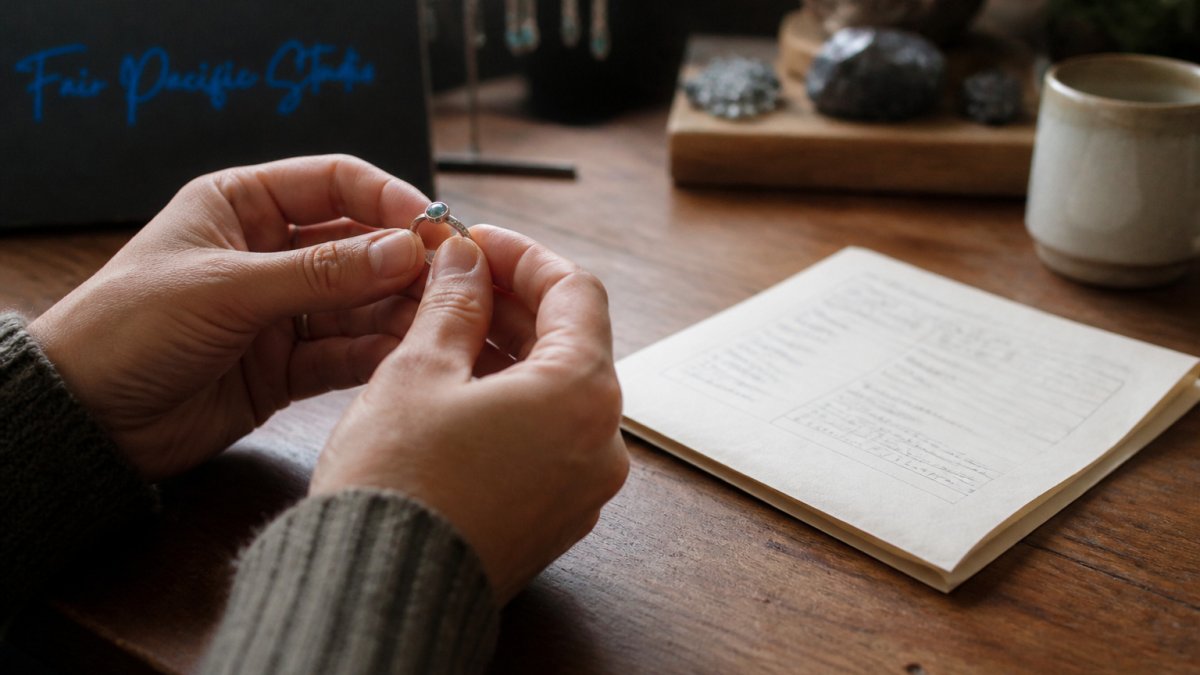
Ask whether the seller can share:
- A supplier invoice that names the mine, dealer, or cutter, with a date and a lot or parcel number
- A written statement about the stone's origin tied to a specific lot or stone, not a generic company pledge
- Any audit or third-party verification the supplier has undergone, with the auditor's name and the date of the audit
- Cutting and polishing records, since the cutter is often the point where origin information gets lost
What Credible Documentation Looks Like
A useful record has three traits. First, it is specific: it names a mine, a region, a dealer, or a cutter, not just a country or the word "imported." Second, it is dated and tied to a lot or parcel number, so the stone in front of you can be matched to the paper. Third, it is continuous: each step in the chain names the party before it, so you can follow the stone from mine to cutter to seller without a gap.
A common pattern is a single invoice from a dealer with no upstream paperwork. That invoice proves the seller bought the stone from someone. It does not prove where the stone was mined or how. Treat it as one link, not the whole chain.
What Documentation Cannot Prove
Be realistic about what this gives you. A document only proves what it says. A supplier invoice confirms a transaction, not mining conditions. A written origin statement confirms what the supplier claims, not what happened at the mine. If the supplier is a middleman with no records of their own, the paperwork may just move the question one step back.
This is the honest limit of the process: you are assembling evidence, not certainty. The goal is to see whether the seller's story holds together across documents, or whether each answer stands alone with nothing behind it.
!Hands examining a handmade sterling silver ring with a small stone beside a folded paper supplier document on a wooden table in soft natural light
Step 3: Evaluate Ethical Gemstone Certifications
Certifications can help, but they vary a lot in scope. Some cover mining practices, some cover trade standards, and some only confirm that a stone was tested. Don't assume a certificate means the stone is ethically sourced.
The first thing to understand is that most gemstone certificates are grading reports, not sourcing documents. A grading report from a major gemological laboratory confirms a stone's identity, weight, and quality, whether it is a natural sapphire, whether it has been treated, and how. That is useful, but it says nothing about where the stone was mined or who mined it. A grading report and a sourcing certificate answer different questions.
What a Certificate Can and Cannot Prove
A certificate can confirm a stone's identity, weight, or quality, and some can confirm membership in a program. It usually cannot prove the full history of the stone or guarantee fair treatment at every step.
Sourcing-focused programs tend to work differently. Rather than certifying a single stone, they certify a supplier or a mine against a published standard, and the claim is that the supplier met that standard at the time of an audit. That is a meaningful signal, but it is a claim about a business, not a guarantee about the specific stone in your hand.
How to Verify a Certificate
Verification is a short, practical process:
- Read the issuer's name and look it up independently, not through a link the seller provides
- Check whether the issuer publishes its standards and says what it does not cover
- Look for a certificate or report number you can search on the issuer's own site
- Confirm the certificate matches the stone, same weight, same measurements, same treatment disclosure
- Ask what the certificate covers and, just as important, what it leaves out
A legitimate program will publish its standards and be clear about its limits. If you cannot find the issuer outside the seller's own materials, the certificate is doing less work than it appears to.
Red Flags in Certification Claims
Be cautious of certificates that name no issuer, cannot be verified, or are paired with phrases like "100% ethical" with no explanation. Other warning signs: a certificate that covers only identity but is presented as proof of ethical sourcing, an issuer with no published standard, and a claim that a stone is "certified ethical" without naming the program or the auditor.
Certifications differ in scope, so it helps to check what each one actually covers before trusting it.
| Document type | What it proves | What it does not prove |
|---|---|---|
| Grading report | Identity, weight, quality, treatment | Where the stone was mined or who mined it |
| Sourcing program certificate | Supplier or mine met a published standard at audit | The full history of the specific stone |
| Supplier invoice | A transaction took place with a named party | Mining conditions or upstream origin |
| Written origin statement | What the supplier claims about the lot | What actually happened at the mine |
Responsibly Sourced Gemstone Examples in Practice
Here's how this plays out. Say you're shopping for a sapphire. One seller tells you the stone came from a named mining region, provides a supplier invoice, and says it was cut locally. Another seller says it's "ethically sourced" but can't name the country. The first seller has given you something to check. The second has given you a label.
Responsibly sourced stones also tend to come from smaller, traceable batches or from suppliers who buy directly from known operations. That doesn't guarantee good practices everywhere, but it gives you something specific to evaluate.
Checking Treatments, Enhancements, and Disclosure
A stone's origin is only part of the picture. Many gemstones are heated, oiled, fracture-filled, or otherwise treated to improve their color or clarity. Treatments aren't automatically a problem, but they should be disclosed.
Ask the seller directly whether the stone has been treated. A reputable seller will tell you, and will explain the treatment in plain terms. If a seller is vague about this, treat the origin claims with more caution too.
Booking a Consultation or Shopping the Fair Pacific Studio Catalog Next
If you want to see how a studio answers these questions before you buy, Fair Pacific Studio makes handcrafted jewelry using reclaimed copper, sterling silver, brass, and natural stones. You can browse the jewelry care guides, sizing help, and stories from the studio to learn more about materials and fit.
You can also review the studio's shipping, payment, and returns answers. You can read about the studio and how its pieces are made. Use the same checklist from this guide when you ask any maker where a stone came from.
Frequently Asked Questions
How can you tell if a gemstone is ethically sourced?
You usually cannot confirm it by looking at the stone alone. Ethical sourcing is about where and how the gemstone was mined, cut and sold, so the evidence lives in paperwork and supplier answers. Ask the seller for the country or region of origin, the name of the mine or cutting workshop if known, and any written supplier documentation. A seller who can answer these questions clearly and in detail is giving you a much stronger signal than one who relies on general phrases like eco-friendly or responsibly sourced without specifics.
What questions should I ask a jeweler about a gemstone's origin?
Start with where the stone was mined and where it was cut, since these can be different countries. Ask how the stone moved from mine to sale and who handled it along the way. Ask whether the supplier can provide written documentation, and whether the claim covers the stone itself or only the metal setting. Finally, ask whether the stone has been treated or enhanced and how that was disclosed. Clear, specific answers are a good sign, while vague or changing answers are a reason to look elsewhere.
Can a gemstone certificate prove that it was ethically sourced?
A gemstone certificate from a laboratory such as GIA usually describes identity, weight, color, clarity and cut. It typically does not verify mining conditions or labor practices. Some ethical certifications and chain-of-custody programs address sourcing directly, but they cover specific scopes and have their own limits. Read the certificate or program scope carefully to see exactly what it confirms and what it leaves out.
Are recycled or reclaimed gemstones more sustainable?
Recycled or reclaimed stones avoid new mining, which removes many of the environmental and labor concerns linked to extraction. That is a real advantage, but it depends on the stone's history being documented. Ask how the stone was obtained, whether it came from an estate, a previous piece of jewelry, or a stockpile, and whether the seller can describe that chain. Reclaimed metal settings, such as reclaimed copper or recycled sterling silver, follow similar logic and can be verified the same way.
