
Table of Contents
- Why Easy Clasps Matter in Handmade Jewelry
- Jewelry Clasp Types: A Quick Comparison
- Easy Necklace Clasps for Everyday Wear
- Easy-to-Use Bracelet Clasps for One-Handed Fastening
- Magnetic Jewelry Clasps: Secure Enough for Daily Wear?
- Choosing Clasps for Handmade Jewelry Construction
- Clasp Security by Activity: What Holds Up and What Doesn't
- Frequently Asked Questions
Last Updated: October 16, 2026
Why Easy Clasps Matter in Handmade Jewelry
A clasp is the small fastener that joins the two ends of a necklace or bracelet, and it is the single part of a piece you touch every time you put it on. When I design handmade jewelry, the closure gets as much thought as the stone. A beautiful pendant that takes two hands and a mirror to fasten stays in the box. A simple magnetic or lobster closure gets worn every day.
That is the whole argument of this guide: the clasp decides whether a piece becomes part of your routine or a drawer ornament. Below, I break down the main clasp types, which ones work for one-handed fastening, and how to match a closure to the way you actually live.
Jewelry Clasp Types: A Quick Comparison
Clasp types fall into a few families: lobster and spring-ring, magnetic, hook-and-eye, fold-over, and barrel or push styles. Each trades off security, ease of use, and looks. The table below is the fastest way to see how they stack up, and the notes underneath explain the mechanism behind each one.
| Clasp Type | Ease of Use | Security | Best For |
|---|---|---|---|
| Lobster | Moderate | High | Bracelets, everyday wear |
| Spring ring | Moderate | Medium | Light necklaces |
| Magnetic | Very easy | Low to medium | One-handed fastening |
| Hook and eye | Easy | Low | Delicate, low-movement pieces |
| Fold-over | Easy | Medium | Vintage-style necklaces |
| Barrel / push | Easy | Medium | Symmetrical designs |
Lobster clasp. A spring-loaded gate that opens when you press a small lever on the side. The gate snaps shut on its own, so it stays closed until you deliberately press the lever again. This is why it holds up to daily wear, but the lever is small and hard to feel behind your neck.
Spring ring. A circular ring with a tiny spring-loaded gate that slides back inside the ring. It is lighter and less expensive than a lobster clasp, but the gate is small and the ring can deform if pulled hard. Best reserved for lightweight chains.
Magnetic clasp. Two halves with opposing magnets that snap together when they get close. There is no lever, no gate, and no aiming. The trade-off is that magnet strength varies widely, and a weak magnet releases under a snag.
Hook and eye. A curved hook that slips into a small loop. It is one of the oldest closures and one of the easiest to fasten, but it has no locking mechanism, so it can work loose on a piece that moves a lot.
Fold-over (box) clasp. A tab folds over a small bar and clicks into place. It sits flush against the piece, which makes it popular for vintage and bohemian necklaces, but the fold can loosen over time with repeated opening.
Barrel / push clasp. Two cylindrical halves that screw or push together. It creates a clean, symmetrical line, which suits bracelets and necklaces where the clasp is meant to be seen, but the threads can strip if cross-threaded.
Traditional Clasps vs. Easy-Open Designs
Traditional closures like the lobster and spring ring prioritize security. They use a spring-loaded gate that stays shut until you press a tiny lever. Easy-open designs, by contrast, favor speed and accessibility. A overview of jewelry findings and closures from the Gemological Institute of America is a good reference for how these mechanisms differ in construction.
The trade-off is real. A lobster clasp rarely fails on its own, but it demands fine motor control. A magnetic clasp snaps together in a second, yet it can pop open under a hard tug. Neither is universally better. The right answer depends on the wearer and the piece.
Easy Necklace Clasps for Everyday Wear
For necklaces, the clasp sits behind your neck where you cannot see it, which is why easy necklace clasps matter so much. The most forgiving options are magnetic closures and larger lobster clasps with a textured tab you can feel by touch. A fold-over clasp also works well because it opens and closes with a simple pinch.
- Magnetic clasps snap together with no aiming, ideal for fine chains.
- Large lobster clasps give your fingers something to grip.
- Fold-over clasps suit vintage and bohemian designs.
- Hook-and-eye closures keep delicate pieces light.
If a necklace is heavy, pair an easy closure with a small safety catch so it cannot drop if the main clasp opens.
Easy-to-Use Bracelet Clasps for One-Handed Fastening
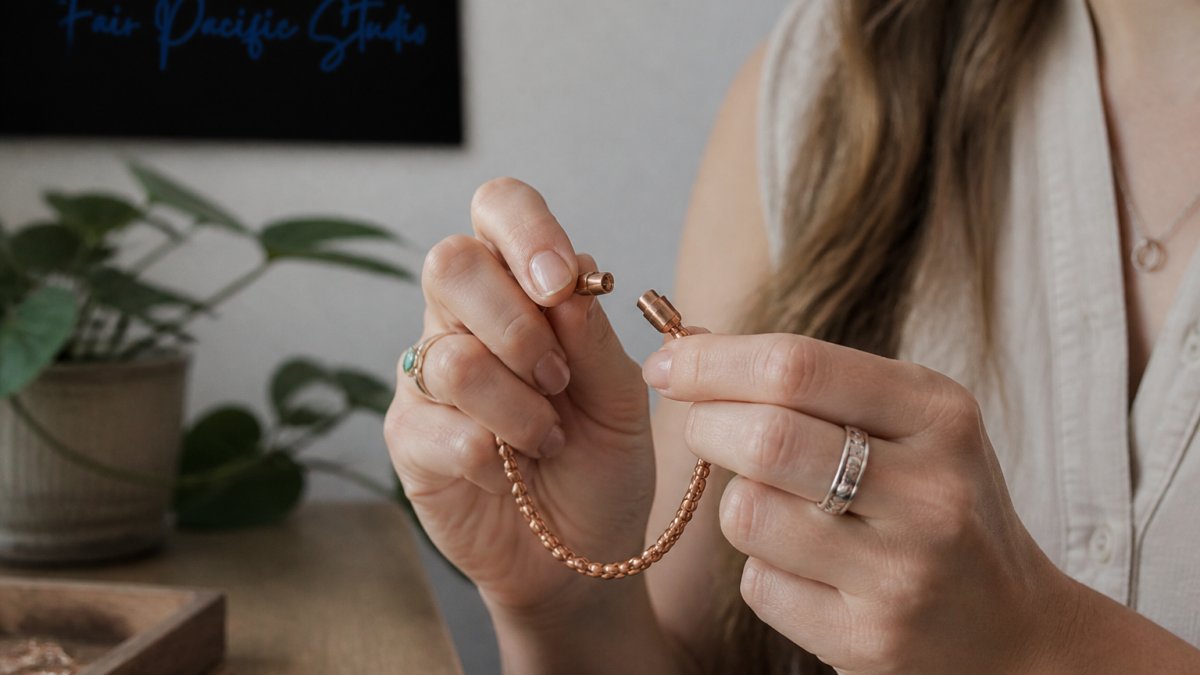
Bracelets are the hardest pieces to fasten alone because both ends sit at your wrist. The best easy-to-use bracelet clasps for one-handed fastening are magnetic closures and slider or push-style clasps that click together without a lever. Magnetic clasps win here because the two halves find each other.
If you have arthritis or limited grip, this is the category to focus on. A magnetic closure turns a two-hand struggle into a one-second click. For a piece like a copper cuff, a hidden magnetic catch keeps the line clean while staying accessible.
Magnetic Jewelry Clasps: Secure Enough for Daily Wear?
Magnetic jewelry clasps are secure enough for daily wear on light necklaces and most bracelets, but they are not the right choice for heavy pendants or high-impact activity. The magnet strength varies widely, and a weak magnet will release when the piece snags.
Here is how I think about it: a magnetic clasp is a convenience feature, not a security feature. For a delicate everyday necklace, that is a fair trade. For a statement piece with a heavy stone, use a lobster or fold-over clasp and keep the magnet for a bracelet.
- Great for: fine chains, lightweight bracelets, one-handed wearers.
- Poor for: heavy pendants, sports, anything that gets yanked.
- Upgrade move: add a safety catch alongside the magnet.
Choosing Clasps for Handmade Jewelry Construction
Choosing a clasp for handmade jewelry construction comes down to matching the closure's weight and finish to the piece, then building the attachment points around how that specific clasp opens. A chunky lobster clasp on a fine chain looks wrong and adds unnecessary weight. A tiny spring ring on a heavy bracelet will fail.
Here is a construction sequence, and the specifics that matter at each step.
1. Pick the clasp before you finish the ends. The clasp dictates the size of the attachment loop. A lobster clasp needs a jump ring large enough for the gate to pass through, usually 4 mm or wider for a standard 10 mm lobster. A spring ring needs a loop small enough that the ring cannot slide off, but open enough that the gate clears it.
2. Match the wire or chain gauge to the clasp weight. A heavy lobster clasp on 20-gauge wire will pull the wire out of shape. A lightweight spring ring on a thick chain looks undersized and can bend open. As a rule, the clasp should feel like it belongs to the same weight class as the chain or wire it connects to.
3. Choose the loop style based on how the clasp opens. A lobster clasp hooks onto a closed loop. A spring ring hooks onto a closed loop. A hook-and-eye closure needs one open hook and one closed loop. A fold-over clasp usually attaches to a flat tab or a soldered end cap rather than a round jump ring. Building the wrong loop style means the clasp will not seat properly.
4. Match metal and finish to the rest of the design. Sterling silver, brass, and copper all take different patinas, and the clasp should match the rest of the piece so the closure disappears into the design. If the piece is oxidized, oxidize the clasp too. If the piece is polished, polish the clasp.
5. Consider the attachment point on both ends. Most clasps need a jump ring on one end and a chain or loop on the other. The jump ring should be soldered closed on at least one side so it cannot work open. If you use an unsoldered jump ring, the wearer can lose the piece even if the clasp itself holds.
- Match clasp weight to the piece's weight.
- Match metal and finish to the rest of the design.
- Choose the loop style based on how the clasp opens.
- For a handmade look, a hand-formed wire clasp or a decorative shape can become part of the design.
For makers who sell their work, the U.S. Consumer Product Safety Commission guidance on jewelry safety is worth reviewing, since small clasps and components fall under general product safety expectations.
Clasp Security by Activity: What Holds Up and What Doesn't
Clasp security should match your activity, not just your taste. A closure that is perfect for a desk job may be the wrong pick for a hike or a gym session. The table below maps common activities to the closures that hold up.
| Activity | Best Clasp | Avoid |
|---|---|---|
| Office / everyday | Lobster, fold-over | Weak magnets |
| Exercise / sports | Lobster with safety catch | Hook and eye |
| Swimming | Lobster, barrel | Magnetic |
| Sleeping | Magnetic, fold-over | Long dangling hooks |
| Formal events | Fold-over, magnetic | Loose spring rings |
For anything with impact or water, choose a mechanical clasp with a locking gate and add a safety catch. For calm, low-movement settings, an easy-open design is the better experience. The U.S. Consumer Product Safety Commission guidance on jewelry safety is worth a look if you make or sell jewelry, since small clasps and components fall under general product safety expectations.
The challenge with handmade jewelry is that no two pieces or two wearers are alike, so a one-size clasp recommendation rarely fits. At Fair Pacific Studio, I handcraft each piece one at a time using reclaimed copper, sterling silver, brass, and natural stones, and I can talk through which closure suits your grip, your routine, and the design you love. Every piece blends bohemian character with modern minimalism, so an easy clasp never has to look like a compromise. Shop the catalog and find a piece built to be worn, not wrestled with.
Frequently Asked Questions
What is the best type of clasp for necklaces?
The best clasp depends on your needs. Magnetic clasps are easiest to fasten one-handed but may not suit high-impact activity. Lobster clasps are secure and widely available but can be fiddly. For everyday wear with limited dexterity, a magnetic clasp or a large spring-ring clasp works well. For necklaces you rarely remove, a barrel clasp offers a clean look. Consider the necklace's weight and your daily activities before choosing.
Which jewelry clasps are easiest to use with one hand?
Magnetic clasps are the easiest for one-handed fastening because they snap together with minimal effort. Push-style or slider clasps also work well since they require only a simple push or slide motion. Large lobster clasps with a wide opening can be manageable, especially with a clasp helper tool. Fold-over clasps are difficult one-handed. If you have arthritis or limited hand strength, magnetic and push clasps are your best options.
Are magnetic clasps secure enough for everyday jewelry?
Magnetic clasps vary in strength. Strong neodymium magnets hold well for lightweight necklaces and bracelets during normal daily activities. However, they can separate during vigorous exercise or if snagged. For everyday wear, choose a magnetic clasp rated for the weight of your piece. If you're active or wear heavy jewelry, a lobster or fold-over clasp may be more secure. Many people use magnetic clasps for convenience and switch to traditional clasps for high-impact days.
Can a jeweler replace a difficult jewelry clasp?
Yes, most jewelers can replace or upgrade a clasp. The cost depends on the clasp type and metal. Replacing a simple spring-ring with a magnetic clasp is usually straightforward. For handmade or delicate pieces, find a jeweler experienced with artisanal jewelry. If you bought from a small studio, contact the maker first; they may offer repairs or adjustments. Always ask about turnaround time and whether the new clasp matches the piece's style.