
Last Updated: October 30, 2026
Quick Summary
To choose artisan gemstone jewelry that lasts, start with gemstone hardness on the Mohs scale: stones rated 7 and above, such as quartz, amethyst, sapphire, and ruby, suit everyday rings, while stones below 6 belong in earrings or pendants. Then confirm a crisp hallmark, a secure bezel or prong setting, and written disclosure of the stone's species and treatments.
- Hardness measures scratch resistance on the Mohs scale, while toughness describes resistance to chipping and breaking.
- A 925 stamp on silver means 92.5 percent silver, which is sterling silver.
- Ask whether a stone is natural, lab-created, or assembled, and whether it has been treated.
- For gardening, cooking, or gym wear, skip opal, pearl, moonstone, and turquoise in rings entirely.
- Skip ultrasonic cleaners on opals, pearls, emeralds, and turquoise, and check prongs twice a year.
Table of Contents
- Start With Gemstone Hardness and Wearability
- How to Identify High-Quality Handmade Jewelry
- Natural vs Synthetic Stones and Gemstone Authenticity
- Match the Piece to Your Lifestyle and Clasp Needs
- Ethical Sourcing and Traceability in Artisan Jewelry
- Handmade Bohemian Accessories for Women: Finding Your Style
- How to Care for Artisan Gemstone Jewelry
- Shop the Fair Pacific Studio Collection
- Frequently Asked Questions
Start With Gemstone Hardness and Wearability
Learning how to choose artisan gemstone jewelry starts with one question most buyers skip: will this stone survive daily life? Hardness, not beauty, decides whether a ring still looks right in five years.
Gemstone durability is measured on the Mohs scale, a 1-to-10 ranking of scratch resistance (gia.edu). Talc sits at 1; diamond sits at 10. The Gemological Institute of America's gem encyclopedia explains that hardness measures resistance to scratching, while toughness describes resistance to chipping and breaking. Those are different properties, and both matter.
Reading the Mohs Scale for Everyday Wear
Here is the practical translation for a ring you never take off:
- 7 and above: quartz, amethyst, citrine. Fine for everyday rings with reasonable care.
- 8 to 8.5: spinel, topaz. Good wearability for most people.
- 9: sapphire and ruby. Among the most wearable colored stones.
- 10: diamond. Maximum scratch resistance.
- Below 6: opal, pearl, moonstone, turquoise. Better suited to earrings, pendants, or occasional wear.
A common mistake is buying a soft stone in a prong setting for a daily-wear ring. The stone chips at the girdle within months, and no jeweler can undo that.
Here is how Mohs hardness translates into everyday wearability for a ring.
| Mohs hardness | Gemstones | Everyday wear note |
|---|---|---|
| 7 and above | Quartz, amethyst, citrine | Fine for everyday rings with reasonable care |
| 8 to 8.5 | Spinel, topaz | Good wearability for most people |
| 9 | Sapphire and ruby | Among the most wearable colored stones |
| 10 | Diamond | Maximum scratch resistance |
| Below 6 | Opal, pearl, moonstone, turquoise | Better for earrings, pendants, or occasional wear |
How to Identify High-Quality Handmade Jewelry
High-quality handmade jewelry shows three things at once: a clean hallmark, a secure setting, and hand-finished surfaces. For a deeper look at why artisan quality matters, read the full article. If any one is missing, slow down before you buy.
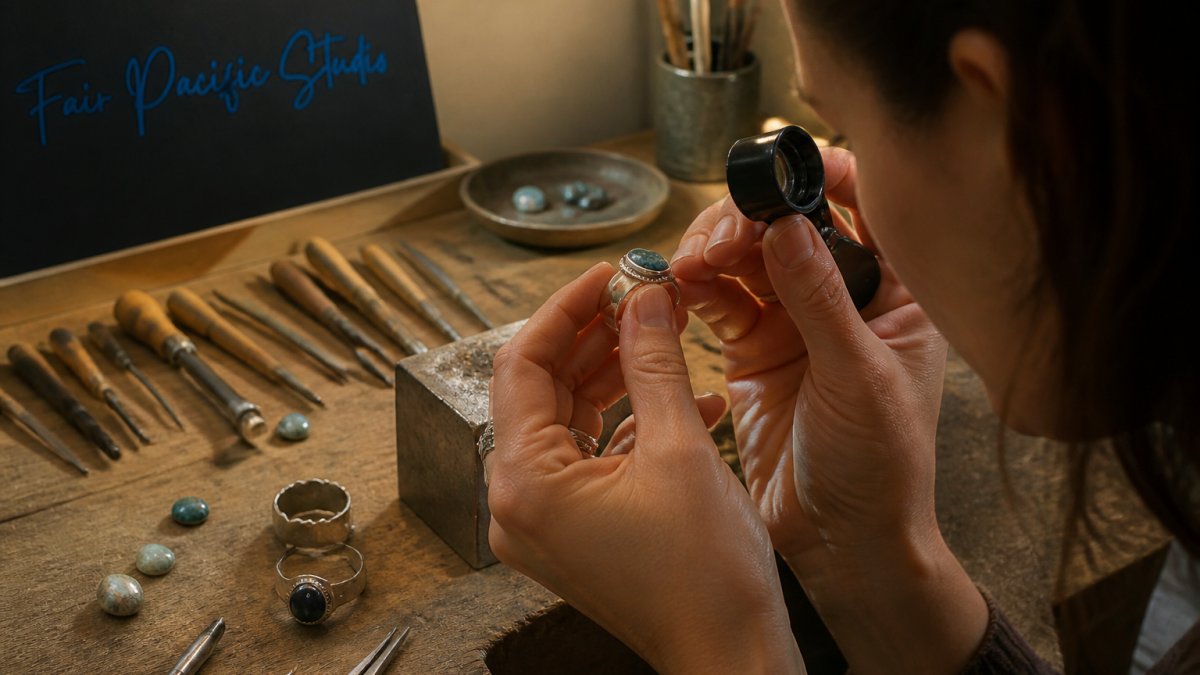
Start with a loupe or a phone macro lens and work through the piece systematically.
Hallmarks, Stamps, and Setting Integrity
A hallmark is an official mark struck into precious metal that indicates its fineness. In the United States, the Federal Trade Commission's jewelry guides require quality marks on precious metal jewelry to be accurate and accompanied by the maker's or dealer's mark. A 925 stamp on silver means 92.5 percent silver, which is sterling silver.
Check these points:
- The stamp is crisp and legible, not blurry or shallow.
- A maker's mark sits beside the quality mark.
- The bezel setting or prong setting holds the stone with no visible gap.
- Prongs are uniform and rounded, not snagged or uneven.
- The surface finish inside the band is smoothed, not left rough.
Setting integrity is where handmade pieces separate from mass-produced ones. A hand-set stone sits level, with prongs that contact the stone evenly.
Natural vs Synthetic Stones and Gemstone Authenticity
Natural stones form in the earth over millions of years; synthetic stones are grown in a lab with the same chemical composition and crystal structure. Both can be beautiful and durable. The problem is paying natural-stone prices for a lab-grown stone without being told, and that is a disclosure failure, not a quality failure.
Gemstone authenticity comes down to three things: what the stone is, how it was treated, and what documentation backs it up. Reputable makers state all three plainly.
The Disclosure Questions That Actually Matter
Ask directly, and listen for specific answers rather than reassurance:
- Is this stone natural, lab-created, or assembled? Assembled stones (doublets and triplets) are layers of material glued together, common in opal and some turquoise, and should be labeled as such.
- Has it been treated, and how? Heat treatment is standard and permanent for sapphire, ruby, and amethyst. Fracture filling (common in emerald), diffusion treatment (common in sapphire and topaz), and irradiation (common in blue topaz) are also legitimate when disclosed. Dyeing and stabilization are common in turquoise and lapis.
- Is the treatment permanent or does it require care? Filled emeralds should never go in an ultrasonic cleaner; dyed stones can fade with sun exposure. A seller who knows this will tell you.
- What documentation comes with it? A receipt with the stone described in writing is the minimum. For significant purchases, an independent appraisal or a report from a recognized gemological lab adds real protection.
Reading Inclusions and Pricing Signals
Gemstone inclusions are often a good sign. Natural stones usually carry tiny internal marks, wisps, crystals, feathers, that formed with the stone. Perfectly clean stones at low prices deserve scrutiny, especially in varieties where eye-clean natural material is rare and expensive.
A useful rule of thumb: if the price seems too good for the size and clarity, ask what the stone actually is before you fall in love with the setting. Lab-created stones are not inferior, they are simply a different product with a different price, and the buyer deserves to know which one they are getting.
A jewelry appraisal from an independent gemologist is worth the fee on any significant purchase, and it protects you if you ever need to insure the piece.
Match the Piece to Your Lifestyle and Clasp Needs
The best artisan gemstone jewelry is the piece you actually wear, and that means matching the design to your hands, your routine, and your dexterity. Most guides stop at "consider your lifestyle." This one gives you the specific pairings and the trade-offs behind them.
Stone-to-Activity Pairings That Hold Up
Match the stone to what your hands actually do, not to what you wish they did:
- Office and desk work: sapphire, ruby, spinel, and quartz-family stones in bezel settings survive keyboard, mouse, and door handles without girdle chips.
- Gardening, cooking, gym: a bezel-set sapphire or a low-profile band works; skip opal, pearl, moonstone, and turquoise in rings entirely. These belong in earrings or pendants where they take less impact.
- Travel: a single bezel-set stone on a secure chain or a flush-set band travels better than prong-set pieces that snag on luggage and clothing.
- Hands-on trades (nursing, teaching, mechanics): consider a pendant or earrings as your daily piece and save rings for off-duty wear. A soft stone in a prong setting will chip at the girdle within months, and no jeweler can undo that.
A soft opal in a bezel pendant survives office life; the same stone in a prong-set ring does not survive gardening. The setting matters as much as the stone.
Clasps and Dexterity: The Overlooked Specification
Clasps are the most overlooked specification. If you have arthritis or limited grip strength, a tiny spring ring on a fine chain can be a daily frustration. Look for closures that are easy to operate without pinching. Ask the maker which closure styles their pieces use before you buy. For practical guidance, see the guide to handmade jewelry with easy clasps.
Ethical Sourcing and Traceability in Artisan Jewelry
Ethical sourcing means the maker can tell you where the metal and stones came from and how they were obtained. Traceability is that story written down.
Ask for specifics, not slogans. "Sustainably sourced" without detail is marketing. Useful answers sound like: reclaimed silver from a specific refiner, stones bought from a named lapidary, or vintage stock repurposed into new work.
Reclaimed metal matters because it avoids new extraction. For a broader look at shopping with purpose, see the ethical consumerism guide.
Handmade Bohemian Accessories for Women: Finding Your Style
Handmade bohemian accessories for women work best when the piece fits a wardrobe you already own, not a trend you are testing.
Artisan craftsmanship shows in asymmetry and texture.
The artisan aesthetic is not the same as trendy. Bohemian design leans on natural materials and organic shapes, which age well.
A simple test before buying: picture the piece with three outfits you already wear. If it works with all three, it will earn its place.
How to Care for Artisan Gemstone Jewelry
Caring for artisan gemstone jewelry takes minutes a week and prevents most long-term damage. The routine is simple, and the mistakes are predictable.
- Put jewelry on last. Perfume, hairspray, and lotion leave residue on stones and dull metal.
- Remove before water. Chlorine and hot water degrade settings and some stones.
- Store pieces separately. Gemstones scratch each other; a soft pouch per piece solves it.
- Clean with a soft cloth. A Sunshine Cloth lifts tarnish from silver, gold, brass, and copper without liquid polish.
- Check prongs twice a year. A loose prong is a lost stone waiting to happen.
Skip ultrasonic cleaners on opals, pearls, emeralds, and turquoise. The vibration and heat can damage them.
**
Shop the Fair Pacific Studio Collection
At Fair Pacific Studio, I make each piece by hand in small batches, working in reclaimed copper, sterling silver, brass, and natural stones.
If you have dexterity concerns, you are welcome to ask me about closures before you order.
Browse the full collection of handmade pieces to find your fit.
Frequently Asked Questions
How can you tell if artisan gemstone jewelry is high quality?
Look at the details a maker cannot fake. Check for a clean 925 stamp or hallmark on sterling silver, smooth bezel or prong settings with no gaps, and hand-finished surfaces that feel even rather than sharp. Ask about the stone's hardness on the Mohs scale and whether it suits daily wear. A quality piece also comes with clear care instructions and a maker willing to answer questions about construction and materials before you buy.
Are natural gemstones better than synthetic for artisan pieces?
Neither is automatically better; they serve different needs. Natural stones carry inclusions and color variation that make each piece one-of-a-kind, which suits the artisan aesthetic. Synthetic stones offer consistent color and often higher durability for everyday wear. What matters most is that the maker tells you which one you are buying. Ask directly whether the stone is natural, treated, or lab-created, and get that in writing.
How do I care for artisan gemstone jewelry so it lasts?
Store each piece separately in a soft pouch to prevent scratches, and remove rings and bracelets before cleaning, swimming, or gardening. Clean with lukewarm water and a drop of mild soap, then dry with a soft cloth. Avoid ultrasonic cleaners on softer stones or treated gems. Check prongs and clasps every few months, and take the piece to a jeweler for tightening if anything feels loose. Proper care keeps artisan gemstone jewelry wearable for decades.
What should I look for when buying handmade gemstone jewelry online?
Ask for close-up photos of the setting, the hallmark, and the stone itself. Confirm the metal type, stone origin, and whether the piece is one-of-a-kind or made in multiples. Read the return policy before you buy, especially for fit and color accuracy. A reputable maker will answer questions about sourcing and construction without hesitation. If the listing is vague about materials or the maker will not confirm details, look elsewhere.
Choosing well comes down to hardness, honest disclosure, and a maker who will still answer your questions in five years. Fair Pacific Studio builds every piece for that timeline: handcrafted one at a time, inspired by the Pacific Northwest, and made from reclaimed copper, sterling silver, brass, and natural stones. Get started with Fair Pacific Studio and find a piece that stays with you.
