
Last Updated: October 28, 2026
Quick Summary
Styling copper jewelry for beginners starts with anchoring it against cream, denim, olive, burgundy, forest green, plum, or black so the warm metal stands out. Match each piece's visual weight to your neckline, layer necklaces two or three at a time with varied lengths, and keep copper dry to slow tarnish.
- Cream and ivory soften copper's orange tone and make it look almost golden.
- Layer two or three necklaces and vary their lengths by at least a couple of inches.
- Copper sits between silver and gold on the warmth scale, so it bridges both metals.
- A handmade statement piece should be the loudest thing you're wearing, not one of five.
- Remove copper before workouts, showers, swimming, and cleaning with harsh chemicals.
Table of Contents
- Why Copper Jewelry Deserves a Place in Your Everyday Rotation
- Copper Jewelry Outfit Ideas for Real Life
- How to Layer Copper Necklaces Without the Tangled Mess
- Mixing Copper Jewelry with Silver and Gold
- Balancing Handmade Statement Pieces with Your Outfit
- Copper Jewelry Care and Tarnish Prevention
- Choosing Your First Handcrafted Copper Piece from Fair Pacific Studio
- Frequently Asked Questions
Why Copper Jewelry Deserves a Place in Your Everyday Rotation
Copper jewelry is warm, affordable, and gets better looking the more you wear it. That last part is why I keep coming back to it.
At Fair Pacific Studio, I work with reclaimed copper. Below, I'll walk you through outfit formulas, layering tricks, metal mixing, and care so your first copper piece earns a permanent spot in your rotation.
Here's what most styling guides get wrong. They treat copper like a cheaper stand-in for gold. It isn't.
Copper Jewelry Outfit Ideas for Real Life
The easiest way to wear copper jewelry is to anchor it against colors that let the metal stand out. But color is only half the formula.
The Neutral Anchor: Cream, Denim, and Olive
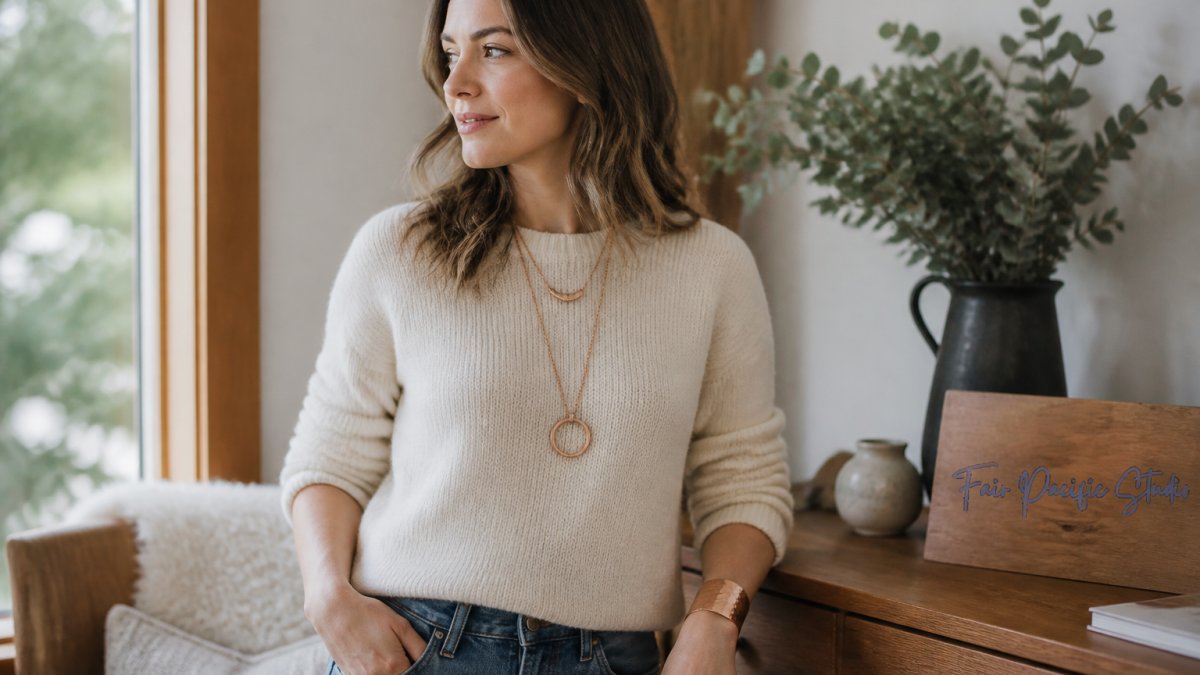
Cream, denim, and olive are the safest starting point for any beginner. These shades sit quietly while copper does the talking.
- Cream and ivory: softens the orange in copper and makes it look almost golden
- Denim: the blue-gray tones create a clean contrast that reads casual, not flashy
- Olive and khaki: earthy greens echo the raw, natural feel of handcrafted copper
Try a plain cream tee, your favorite jeans, and one hammered copper cuff. That's it. The outfit works because nothing competes.
Deep Hues That Make Copper Glow
Deep colors are where copper really shows off. Burgundy, forest green, and plum all push the metal forward.
- Burgundy: brings out copper's red undertones
- Forest green: the classic pairing for warm metals, and it suits copper best
- Plum: adds richness without going too dark
A copper pendant on a black top needs no other styling. The contrast does the work.
Four Beginner Formulas, One Per Piece Type
Color palettes are the starting point.
1. The hammered cuff. Wear it with a cream or white long-sleeve tee and straight-leg jeans for a weekend errand run.
2. The copper drop earrings. Pair with a boat-neck or scoop-neck top in olive or rust.
3. The copper pendant necklace. Wear it over a black turtleneck or a forest-green crewneck for evening.
4. The copper stacking ring. Pair with a plain white button-down and rolled sleeves for the office.
Styling Copper for Your Skin Tone and Personal Style
Copper is one of the few metals that flatters every skin tone, but the shade of copper matters. Lighter, polished copper pops against deep skin tones and reads almost rose-gold on fair skin.
Personal style matters as much as skin tone. If your wardrobe leans minimalist, let one copper piece carry the outfit and keep everything else silver or neutral.
How to Layer Copper Necklaces Without the Tangled Mess
Layering copper necklaces works best when you vary length by at least a couple of inches and keep the total to two or three pieces. Start with a short chain, add a mid-length pendant, then finish with a longer piece if you want more depth.
The tangle problem is real, and it's usually a length issue, not a clasp issue. Two necklaces at nearly the same length will twist together no matter how carefully you put them on.
Here's the layering order I recommend:
- Shortest first: a choker or collar-length chain sits closest to your neck
- Mid layer second: a pendant that falls near the collarbone
- Longest last: a lariat or longer chain that drops below the first two
Mix textures too. If you want the full breakdown of lengths and how to measure for them, see my guide on necklace sizes. And if you're new to layering in general, this piece on how to layer necklaces for minimalist style covers the spacing rules in more detail.
Watch out: layering three or more chains of similar weight and length is the fastest route to a knotted mess at the end of the day.
Mixing Copper Jewelry with Silver and Gold
Mixing copper with silver and gold is fine, and the old "never mix metals" rule is outdated. The trick is balance, not avoidance.
Copper sits between silver and gold on the warmth scale, which makes it a natural bridge. Pair copper with silver for a cooler, more modern look.
A few combinations that work:
- Copper cuff plus silver rings: the contrast feels intentional and clean
- Copper pendant plus a thin gold chain: warm on warm, subtle and layered
- All three metals together: keep one metal dominant and let the other two play supporting roles
What most guides miss is proportion. If you wear equal amounts of every metal, the look gets busy fast.
Balancing Handmade Statement Pieces with Your Outfit
A handmade statement piece should be the loudest thing you're wearing, not one of five loud things. That's the whole rule.
Handcrafted copper jewelry often has visible texture: hammer marks, irregular edges, a stone set slightly off-center. Those imperfections are the point.
Here's how I'd balance it:
- One statement, rest simple: a bold copper cuff with a plain tee and jeans
- Scale to your frame: a large pendant on a petite frame reads bigger than it does on a taller one
- Match texture, not color: pair a hammered cuff with a linen shirt, not a sequined top
If you're coming from mass-produced jewelry, expect the weight to feel different. Handmade copper pieces are often heavier and sit differently on the wrist.
Copper Jewelry Care and Tarnish Prevention
Copper tarnishes. That's not a flaw, it's chemistry, and it's manageable with a few habits. But tarnish is only half the care story. Beginners also ask about green skin, skin sensitivity, and when to take a piece off. Here's the full picture.
Why Copper Turns Skin Green (and What to Do About It)
A green tint on your skin is the most common beginner worry, and it's harmless. Copper reacts with sweat, skin oils, and the acids in lotions to form a thin green layer of copper salts.
A few ways to reduce it:
- Keep the piece dry: take copper off before workouts, showers, and dishwashing
- Apply lotion and perfume first: let them dry fully before putting jewelry on
- Seal the inner surface: a thin coat of clear jewelry lacquer on the side that touches skin slows the reaction, though it wears off over time and needs reapplication
The green washes off with soap and water. It is not a sign of low-quality copper, and it does not mean the piece is damaging your skin.
Skin Sensitivity and When to Remove Copper Jewelry
Most people wear copper without issue, but a small share develop itching, redness, or a rash under a piece. That reaction is usually to the alloys mixed into the copper or to a nickel-containing clasp rather than to copper itself.
A common pattern is to start with short wear sessions. Wear a new cuff for an hour, then two, and watch for irritation. If redness appears, remove the piece and clean the skin. Persistent reactions are worth a dermatologist's opinion.
Remove copper jewelry before:
- Swimming, especially in chlorinated pools, which strip finishes fast
- Showering, since soap and hot water speed tarnish
- Heavy sweating, because salt accelerates the green reaction
A Simple Tarnish and Cleaning Routine
The main causes of fast tarnish are moisture, lotions, and air. Keep copper dry and store it in a sealed bag or a lined box when you're not wearing it. Put jewelry on last, after lotion and perfume have dried.
A simple care routine:
- Wear it often: the oils in your skin actually slow tarnish on some pieces
- Wipe after wearing: a dry soft cloth removes oils and moisture
- Clean gently: a paste of lemon juice and salt works, but rinse and dry fully
For safe, specific cleaning methods, my guide on how to clean reclaimed copper jewelry walks through seven options that won't damage the surface.
How Finish and Patina Change the Care Rules
Polished copper shows fingerprints and tarnish fastest, so it needs the most wiping. Hammered copper hides small marks in its texture and tolerates less frequent cleaning.
Handmade variation matters here too. A piece with an irregular surface may tarnish unevenly, which is normal and part of the look.
Here's a quick reference for when to take copper jewelry off and how to keep it looking its best.
| Situation | Action | Why |
|---|---|---|
| Workouts and heavy sweating | Remove the piece | Salt accelerates the green reaction |
| Showers | Remove before washing | Soap and hot water speed tarnish |
| Swimming | Remove, especially in chlorinated pools | Chlorine strips finishes fast |
| Lotion and perfume | Apply first, let dry fully | Reduces green skin tint |
| Cleaning with harsh chemicals | Remove the piece | Chemicals can pit the surface |
| After wearing | Wipe with a dry soft cloth | Removes oils and moisture |
| Storage | Sealed bag or lined box, dry room | Moisture and air cause fast tarnish |
| Polished copper | Wipe after every wear | Shows fingerprints and tarnish fastest |
Choosing Your First Handcrafted Copper Piece from Fair Pacific Studio
Your first piece should be one you'll actually wear weekly. For most beginners, that's a cuff or a simple pendant, not a full set.
At Fair Pacific Studio, every piece is made one at a time from reclaimed copper, sterling silver, brass, and natural stones.
Before you buy anywhere, it helps to know what real copper looks like. My guide on how to identify authentic copper jewelry covers the tell-tale signs of imitations. If you want a concrete starting point, the Malachite & Hammered Copper Circle Pendant Necklace is a good example of how a single stone and a textured copper ring come together in one piece.
Best for: beginners who want one versatile piece they can wear with neutrals and deep hues alike.
Frequently Asked Questions
How do you style copper jewelry for everyday wear?
Start with one or two pieces and build from there. A simple copper cuff or a short pendant necklace works with jeans and a tee as easily as it does with a blouse. Stick to neutral clothing colors like cream, olive, or denim so the warm tone of the copper stands out. If you wear multiple pieces, keep the scale varied: a thin chain next to a wider cuff looks intentional, while two chunky pieces compete. Let it become part of your daily routine rather than saving it for special occasions.
Can you wear copper jewelry with silver or gold?
Yes, mixing metals is one of the easiest ways to make copper jewelry feel modern. The key is to repeat each metal at least twice so the combination looks deliberate. For example, pair a copper cuff with silver hoops and a silver ring, or layer a copper necklace with a thin gold chain. Keep the finishes consistent: polished copper next to polished silver reads cleaner than pairing a hammered piece with a high-shine one.
What colors go well with copper jewelry?
Copper flatters warm, earthy tones and deep jewel colors. Cream, oatmeal, olive, and denim make a calm backdrop that lets the metal stand out. For contrast, try burgundy, forest green, plum, or black. These deep hues make the orange-brown of copper look richer. Avoid very cool, icy pastels if you want the copper to be the focus, since they can wash out its warmth. A simple rule: if the color looks like it belongs in a forest or a sunset, it will probably work with copper.
How do you keep copper jewelry from tarnishing?
Copper darkens naturally when it meets air and moisture, but you can slow that down. Store pieces in a dry, airtight container or a soft pouch, and put jewelry on last after lotions and perfume have dried. Remove copper before showering, swimming, or heavy sweating. To clean, use a soft cloth with a little mild soap and water, then dry completely. A gentle polish with a jewelry cloth restores shine. Some people enjoy the aged patina that develops, but if you prefer a bright finish, regular wiping keeps the tarnish in check.
A good copper piece should feel like it was made for you, not pulled off a shelf. That's the standard I hold at Fair Pacific Studio: handcrafted one at a time, inspired by the Pacific Northwest, and built from reclaimed copper, sterling silver, brass, and natural stones. Start with one piece, layer it slowly, and let the patina tell the story. Get started with Fair Pacific Studio and find a handcrafted copper piece that fits your everyday rotation.
